Comparison
DJI Air 3 vs DJI Air 3S
Would you notice?
Air 3 vs Air 3S: You would notice the sensor (1/1.3-inch CMOS vs 1-inch CMOS) in evening light; you would notice max video only if you slow-mo or grade HDR. You would not really notice obstacle sensing, internal storage. UK: C1, Flyer ID required on every one of these. Operator ID applies because they all have cameras.
Set I fly on the home bench to see net upgrade cost from your airframe (CeX cash vs used / RRP). It stays in this browser.
| Spec | 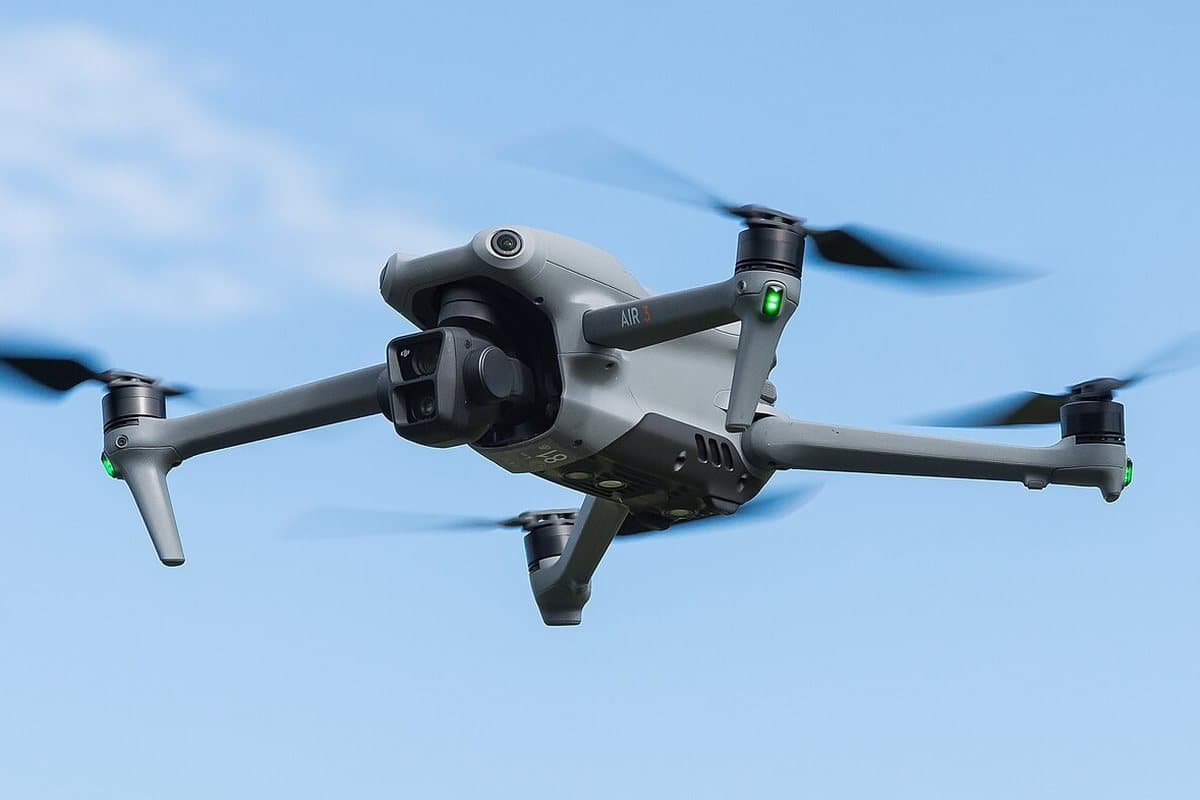 C1 · 720 g | 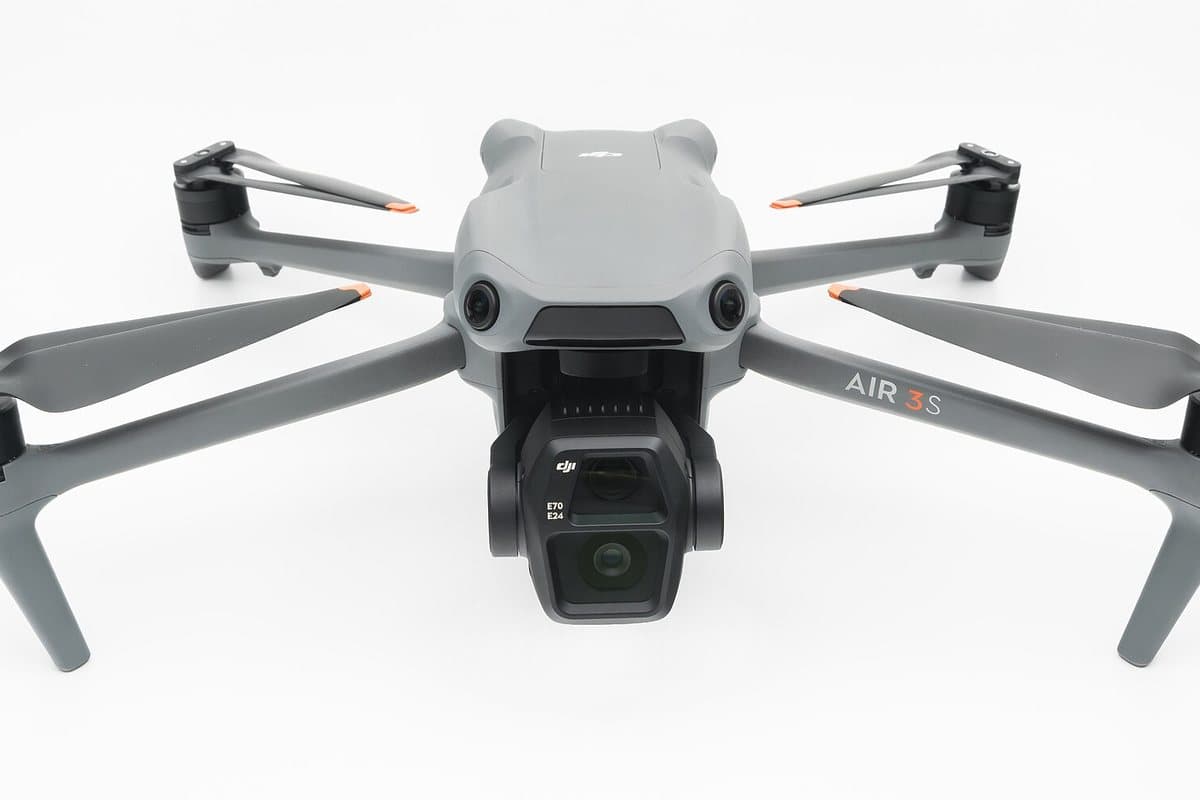 C1 · 724 g |
|---|---|---|
| Identity | ||
ReleasedUsed to order ‘newer’. Firmware and class marks can change after launch (Mini 5 Pro’s C0/C1 battery split is the example). Discontinued as new still belongs in the table if you already own one. DJI product pages | 27 Jul 2023 | 15 Oct 2024 |
AppConsumer DJI camera drones use DJI Fly. Avata also needs Goggles firmware. This is not a different picture; it is which glass is on your face. DJI Fly / Goggles product pages | DJI Fly Same | DJI Fly Same |
| Weight & UK law | ||
Takeoff weightTakeoff weight is what the CAA cares about, not the number on the box without a battery. In the UK, crossing 250 g is the line between a C0/UK0 Mini you can treat as a travel camera and a drone that needs a Flyer ID and tighter distances from uninvolved people. A 4 g swing on the Mini 5 Pro is therefore a legal fact, not trivia. Always weigh the aircraft you actually fly, with the battery you actually use. CAA Drone and model aircraft code | 720 g Same | 724 g Same |
UK class / IDsC0 is under 250 g. C1 is under 900 g. C2 is the next step up and changes where you may fly near people. DJI now prints class marks; some older airframes are unmarked and fall under transitional UK rules. Fitting a heavier ‘Plus’ battery can move a Mini out of C0. The mark on the aircraft you take off with is the one that counts. CAA Drone Code (March 2026) | C1 · Operator ID + Flyer ID Same | C1 · Operator ID + Flyer ID Same |
Open subcategoryThe UK Open category (March 2026 code) splits into A1, A2 and A3. C0 and, until 31 December 2027, C1 fly in A1. C2 needs an A2 Certificate of Competence to use A2 distances; otherwise it is A3. This is not a DJI marketing tier. CAA: getting what you need to fly legally | A1 Over People (C1 until 31 Dec 2027) Same | A1 Over People (C1 until 31 Dec 2027) Same |
From uninvolved peopleA1 (C0, and C1 until 31 Dec 2027): you may fly closer than 50 m and over uninvolved people, but not over crowds or assemblies. A2 (C2 with A2 CofC): 30 m, or 5 m in low-speed mode; no overflight. A3: 50 m from people and 150 m from residential, recreational, commercial or industrial areas. Always 120 m height unless you have other permission. CAA Drone Code — where you can fly | May overfly uninvolved people; not crowds. Flyer ID required. Towns OK in A1. Same | May overfly uninvolved people; not crowds. Flyer ID required. Towns OK in A1. Same |
Height (Open)Open-category flights stay at or below 120 m above the surface unless the CAA has given you something else. Max takeoff altitude on the spec sheet is how high the launch site can be, not a UK height limit. CAA Drone Code | 120 m AGL Same | 120 m AGL Same |
Folded sizeDJI quotes folded without propellers unless noted. A Mini that is 148 mm long is cabin-bag honest. Mavic 4 Pro folded with props is still a day-bag, not a jacket pocket. Avata does not fold — the millimetres are the guarded cinewhoop. DJI aircraft dimensions | 207 × 101 × 92 mm Same | 207 × 101 × 92 mm Same |
| Camera | ||
Main sensorA 1-inch sensor gathers substantially more light than 1/1.3-inch; 4/3 is another step. Megapixels on a small chip mostly crop. In noon sun many of these cameras look closer than the table suggests. After sunset, or in high-contrast interiors, sensor size is the difference you would actually notice in a still or a grade. DJI imaging specs (product pages) | 1/1.3-inch CMOS · 48 MP · 24 mm | 1-inch CMOS · 50 MP · 24 mm Ahead |
Aperturef/1.7–f/1.8 on Mini 5 Pro / Air 3S is the dusk advantage versus older f/2.8 Minis. Hasselblad f/2.8–f/11 (Mavic 3) and f/2.0–f/11 (Mavic 4 Pro) are for depth of field and ND-less bright days. You would notice this in bokeh and in how hard you need an ND, not as a resolution number. DJI camera lens specs | f/1.7 | f/1.8 |
Field of viewMost wide camera drones sit around 82–84°. Mavic 4 Pro’s 28 mm Hasselblad is 72° — tighter, more ‘photo’. Avata is 155°; Avata 360’s lenses are 200°. Comparing FOV across FPV and Mini is usually the wrong argument. DJI lens FOV specs | 84° Same | 84° Same |
ISO (photo / video)100–6400 stills is the DJI default. Video often goes higher (Mini 5 Pro / Air 3S 12800, Avata 25600). A high ISO on a 1/2.3-inch chip is not the same picture as 6400 on 4/3. Treat this row as a capability flag, then look at sensor size. DJI ISO range specs | 100–6400 / 100–6400 | 100–6400 / 100–12800 |
Colour / logD-Log M and HLG are the current consumer pair. Older airframes use D-Cinelike or D-Log. ProRes exists on Mavic 3 Pro Cine, not the standard box. If you do not grade, this row is quiet. DJI colour mode specs | D-Log M / HLG Same | D-Log M / HLG Same |
Other camerasDigital zoom on a Mini is a crop. A 70 mm camera on Air or Mavic is a second optical path: compressed backgrounds, portraits, details you cannot walk to. If your flying is landscapes and holidays, you may never miss it. If you shoot people, architecture or wildlife from a respectful distance, it is the reason to leave the Mini class. DJI Air 3S / Mavic 4 Pro specs | 70 mm 1/1.3-inch CMOS Same | 70 mm 1/1.3-inch CMOS Same |
Max video4K/30 already fills a television. 4K/60 HDR and 4K/120 matter for motion and for highlight recovery in log. 6K on the Mavic 4 Pro Hasselblad is a crop-and-reframe tool as much as a sharpness tool. If you deliver straight from the camera to Instagram, you will not see most of this table. DJI product specs | 4K/60 HDR | 4K/60 HDR, 4K/120 Ahead |
Gimbal / verticalA gimbal that rotates to portrait uses the full sensor; a crop-to-vertical Mini wastes pixels. 225° tilt (Mini 5 Pro) and 360° infinity (Mavic 4 Pro) are for Dutch angles and overheads, not for ‘more stable’. If you only ever shoot landscape 16:9, this row is quiet. DJI Mini 5 Pro / Mavic 4 Pro product pages | 90° tilt Same | 90° tilt Same |
| Flight | ||
Lab flight timeDJI’s published times are wind-tunnel figures at a stated speed until forced landing. Real winter UK flights with 4K, wind and a return home are often 60–70% of that. A 2-minute gap on the spec sheet is not a difference you plan a job around. A 10-minute gap, or a Plus battery that also changes the class mark, is. DJI spec footnotes (wind-tunnel method) | 46 min Same | 45 min Same |
Hover timeHover burns more than DJI’s cruise figure. A 5-minute gap here is real on a mapping or orbit job. A 2-minute gap is weather. Plus batteries change this and, on Mini 5 Pro, can change the class mark. DJI max hovering time footnotes | 42 min Same | 41 min Same |
Wind resistanceMinis are honest in a park and tiring on a headland. Air and Mavic carry more mass into the same Level 5 number, which is why they feel calmer. The published m/s is a maximum resistance, not a comfortable filming envelope. If most of your flying is west-coast or hill, this row beats sensor size. DJI max wind speed resistance specs | Level 5 · 12 m/s Same | Level 5 · 12 m/s Same |
Max speed (CE)UK radios and EU speed caps are CE. Avata’s 27 m/s manual mode is not legal-fast in the EU (19 m/s). Camera drones in the 54–72 km/h CE band feel similar until you fly FPV. You would notice this on a tracking shot or a cinewhoop, not on a park orbit. DJI max horizontal speed (CE notes) | 68 km/h CE · 75.6 FCC Same | 68 km/h CE · 75.6 FCC Same |
Climb / descentMini-class 5 m/s versus Mavic 8–10 m/s is a top-out, not a filming speed. Useful for getting above a cliff or down before rain. You would not notice it on a reveal if you fly Cine mode. DJI max ascent / descent speed | 6 / 6 m/s Same | 6 / 6 m/s Same |
Max takeoff altitude6000 m is a Himalaya number. UK legal height is 120 m above the surface unless you have permission. Neo’s 2000 m and Avata 360’s 4500 m only matter if you take off on a mountain. Do not read this as a UK height limit. DJI max takeoff altitude | 6000 m Same | 6000 m Same |
| Sensing | ||
Obstacle sensingDownward-only (Neo, Mini 3, Mini 4K) will not stop a tree in front of you. Front/back/down (Mini 3 Pro, Flip) is the old Pro pattern. Omnidirectional (Mini 4 Pro and up) adds sides. Nightscape / LiDAR is the dusk version of the same idea, and it still needs texture and a minimum lux. None of this replaces looking. DJI vision system specs | Omnidirectional | Omni + nightscape Ahead |
| Transmission | ||
Video range (CE)UK radios are CE. DJI’s big number is usually FCC (US). CE is typically about half. You also fly visual line of sight. A 10 km CE Mini and a 15 km CE Mavic are the same practical radio for a legal UK flight. Quote CE on this site; treat FCC as a footnote. DJI OcuSync / O4 transmission notes | 10 km CE · O4 (20 km FCC) Same | 10 km CE · O4 (20 km FCC) Same |
| Power & storage | ||
BatteryWh tracks endurance better than ‘Intelligent Flight Battery’ as a name. Mini packs sit around 19–21 Wh; Air ~38; Mavic 3 77; Mavic 4 Pro 95. Families do not cross (Mini 4 Pro packs are not Mini 5 Pro packs). Cabin-bag Wh limits are a travel fact, not a camera fact. DJI intelligent flight battery energy | 38.0 Wh Same | 38.0 Wh Same |
Internal storageA Mini with 2 GB fills in minutes of 4K. 42 GB on Mini 5 Pro is enough to finish a walk if the card fails. Bitrate still wants a fast microSD for anything you care about. Internal storage does not change the picture; it changes whether the flight ends when the card does. Flagship boxes sometimes ship a bigger module (Mavic 4 Pro Creator is 512 GB); the table is the standard airframe. DJI product specs (internal storage) | 8 GB | 42 GB Ahead |
microSDUHS-I Speed Class 3 / V30 is the usual floor. Some airframes list 512 GB, some 1 TB. Neo has no slot. A slow card drops frames; a missing card ends the flight when internal fills. DJI recommended microSD lists | microSD UHS-I Speed Class 3, up to 512 GB Same | microSD UHS-I Speed Class 3, up to 512 GB Same |
GNSSCurrent DJI camera drones are GPS + Galileo + BeiDou. This row is here so a missing constellation would show. It is not a reason to upgrade Mini 4 Pro to Mini 5 Pro. DJI global navigation satellite system | GPS + Galileo + BeiDou Same | GPS + Galileo + BeiDou Same |
Operating temperatureUK winter is inside −10 °C until it is not. Batteries sag before the airframe fails. This row exists so a future airframe with a different envelope would not hide. It is almost always the same number today. DJI operating temperature | −10 to 40 °C Same | −10 to 40 °C Same |
Questions
Will I notice the camera?
Air 3 main: 1/1.3-inch CMOS · 48 MP · 24 mm, 4K/60 HDR. Air 3S main: 1-inch CMOS · 50 MP · 24 mm, 4K/60 HDR, 4K/120. You would notice sensor class in low light; you would not notice the word 4K if both already do it.
Do I need to register the Air 3S in the UK?
Air 3S is C1, takeoff about 724 g (C1. About 724 g takeoff.) so a Flyer ID is required in the UK as well as an Operator ID. This is not legal advice; read the CAA drone code for the airframe and battery you actually fly.
How far from people can I fly the Air 3S in the UK?
Air 3S (C1): A1 Over People (C1 until 31 Dec 2027). May overfly uninvolved people; not crowds. Flyer ID required. Towns OK in A1. Open height is 120 m AGL. Never over crowds. This is not legal advice — the CAA Drone Code (March 2026) applies to the airframe and battery you actually fly.
Which is better at dusk?
Air 3S on paper. Air 3 is 1/1.3-inch CMOS with Omnidirectional; Air 3S is 1-inch CMOS with Omni + nightscape. Nightscape still needs texture and a minimum lux — it is not night vision.
Which is better for travel?
Air 3 if the constraint is a bag and UK class (C1, 720 g). Air 3S if you will accept C1 and 724 g for the extra camera.
Can I keep my Air 3 batteries, controller or ND filters?
You can keep: Air 3 series Intelligent Flight Battery; DJI RC-N2 / RC-N3 (phone holder); DJI RC 2 (built-in screen); Air 3 / Air 3S ND set. You cannot take: DJI RC / RC Pro (O3+). Air 3 and Air 3S share the charging hub; confirm pack label before mixing.
How much more does it cost?
DJI UK RRP (as of 2026-08-31): Air 3 £869, Air 3S £959 — £90 more for the Air 3S. Street, eBay bands and CeX trade-in are on the board; they move.
Who should buy which?
Air 3: Dual camera and wind; you accepted C1. Air 3S: Dual camera and wind; you accepted C1.
Is Air 3S worth it if I already have Air 3?
You would notice the 1-inch wide (Air 3 is 1/1.3 on both cameras) and nightscape sensing. You would not notice another 70 mm — you already have one. Batteries and the charging hub are in the same family; confirm the pack label. If your Air 3 work is daylight telephoto, sit tight unless dusk is the job.
Price board
UK pounds, dated snapshots. Each cell names the box that figure is for. EAN is the barcode on that carton when a UK listing cited one; otherwise we leave it blank rather than guess. Not live APIs. Buying used checklist.
| Air 3 as of 2026-08-31 | Air 3S as of 2026-08-31 | |
|---|---|---|
| DJI Store UK RRP | £869 Air 3 (DJI RC-N2) — not Air 3S | £959 Air 3S (DJI RC-N3) — not Air 3 |
| Amazon UK | See Amazon No new Air 3 (not 3S) buy box — search only | £859 Air 3S with DJI RC-N3 (third-party / Amazon listings) |
| eBay UK band | £600–£850 Used Air 3 Fly More Combo (not Air 3S) | £750–£1,150 Used Air 3S (standard + Fly More; not Air 3) |
| CeX sell | — Air 3 (RC-N2) Fly More Combo, SKU SROBDJIA3RCN2FMA — unpriced | — CeX search — no Air 3S SKU priced; ignore DJI Air 3S lens accessory |
| CeX cash / voucher | See CeX Air 3 (RC-N2) Fly More Combo, SKU SROBDJIA3RCN2FMA — unpriced | See CeX CeX search — no Air 3S SKU priced; ignore DJI Air 3S lens accessory |
Reviews that put these together
- DJI Air 3S vs Mini 5 Pro
Telephoto versus 1-inch Mini, wind, dual camera
YouTube · YouTube · 2025-10-01